
Bio-Intensive Market Gardening :
A Viable Future for Small-Scale Farming
Since the 1950s and 1960s, agriculture in Europe has become increasingly characterized by monocultures, mechanization, and specialization. Farms have grown larger, investments have become more expensive, and many farmers have become dependent on global markets, intermediaries, and fluctuating prices.
As a result, fewer young people see farming as a realistic profession. The financial barriers are high, access to land is difficult, and the pressure to continuously scale up often comes at the expense of ecological resilience and quality of life.
At Claud-du-Moine, we are exploring a different path: bio-intensive market gardening.
Producing More on Less Land
Market gardening is the commercial production of vegetables, fruits, flowers, and other crops on a scale larger than a home garden, but small enough to apply many of the principles of gardening. Typically, market gardens range from 0.1 to 3 hectares.
Bio-intensive market gardening focuses on maximizing productivity on a small area through careful planning, manual labour, and appropriate-scale tools. Rather than relying on large and expensive machinery, the system prioritizes efficiency, soil health, and human-scale agriculture.
By deliberately avoiding heavy equipment, initial investments remain low, making farming more accessible for newcomers and reducing the time needed to achieve financial viability.
Key Principles
Our approach is based on several core principles:
- Permanent beds of approximately 75 cm width, accessible from both sides without stepping on the soil.
- Narrow pathways between beds to maximize productive growing space.
- Continuous succession planting, ensuring that growing areas remain productive throughout the season.
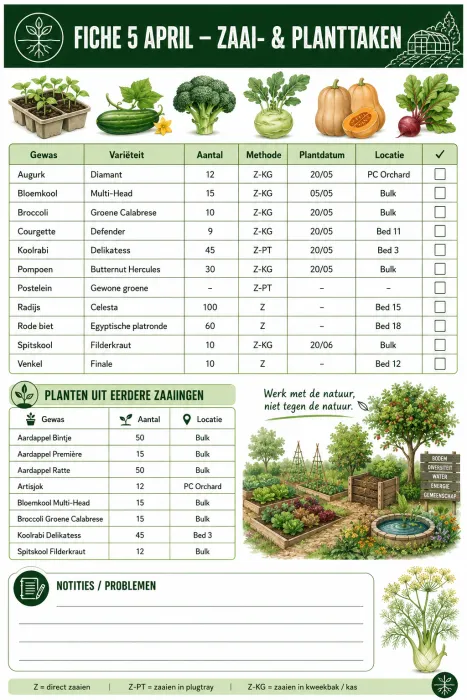
- Detailed planning for sowing, transplanting, cultivation, and harvesting.
- The use of appropriate-scale tools, such as two-wheel tractors and hand tools.
- Continuous improvement of soil fertility through compost, organic matter, and regenerative practices.
These methods allow us to achieve high yields while protecting soil structure and supporting biodiversity.
Healthy Soil, Healthy Food
The foundation of bio-intensive farming is healthy living soil.
By regularly adding organic matter and minimizing soil compaction, we improve soil fertility, increase water retention, stimulate biological activity, and enhance carbon sequestration. Healthy soils produce healthier plants, which in turn provide nutritious food for consumers.
This creates a farming system that is both productive and environmentally responsible.
Strengthening Local Communities
Bio-intensive market gardening is not only about food production. It is also about rebuilding connections between farmers and consumers.
Because production takes place on a smaller scale, growers can sell directly through local markets, vegetable subscriptions, restaurants, and community-supported agriculture initiatives. This shortens supply chains, reduces transportation needs, and keeps more value within the local economy.
A decentralized food system built around many small farms is often more resilient than one dependent on a limited number of large industrial operations.
A Practical Alternative
Bio-intensive market gardening combines traditional farming knowledge with decades of experimentation and modern ecological techniques. It demonstrates that profitable farming does not necessarily require large-scale industrial production.
For us, it represents a practical way to regenerate soil, produce high-quality food, support local communities, and create meaningful opportunities for a new generation of farmers.
Small farms can play a significant role in building a more resilient and sustainable food system. Bio-intensive market gardening shows that sometimes, smaller truly can be better.
_________________________________________________________________________________________________
* Upon request we will mail our sowing and planting calendar to you.
(We use it to maximize production in south-west France, Dordogne region.)